
October 27, 2026 · kixelated
OpenAI still has a WebRTC Problem
On a previous episode, I flamed OpenAI for using WebRTC and it went viral on Hacker News.
thx
A huge shoutout to Sean DuBois and Justin Uberti (WebRTC experts at OpenAI) for reaching out after my unhinged rant.
You could have just said @kixelated ur dumb but you didn’t.
Alas, my divinely anointed crusade against WebRTC is not over. deus vult
Hot Take Alert
Let’s say you’re a vibe coder at a frontier lab working on a voice AI product.
Let’s say you’re making (and burning) an obscene amount of cash.
Let’s say one of your users vocalizes: what is le capital of France?
If your AI ever replies with:
I’m sorry, you broke up, can you repeat that?
You fucked up. You picked WebRTC for voice AI.
The Danger that Lurks Beneath
You boot up your favorite application: ChatGPT™. You click on the microphone and grunt:
What is le capital of France?
OH NO, hypothetical sudden packet loss. A kraken nibbles on some underwater cable. All too common I’m afraid.
WebRTC is designed for conference calls, aka real humans and real voices. It is hyper aggressive and will drop any late audio packets to keep latency real-time. Just like Leonardo DiCaprio, anything above 30ms is too old.
This kind of sucks for a voice AI product. You walk out of wifi range, hit a cellular dead zone, or starlink terminal switches satellites. Oops, your tokens are wasted, or worse, AI tries to guess what you said.
WebRTC can usually detect packet loss and retransmit. But retransmissions are disabled by default for audio. And even when enabled, the audio jitter buffer won’t wait for them.
But why not? Isn’t this networking 101? Just send that shit again?
It’s because of us.
The Speed of You
We flesh bags consume/produce audio in “real-time”, aka a human clock rate. Our neurons can only fire so fast.
For a real-time conferencing product like Google Meet, latency needs to be near zero. Any delay is super fucking annoying, which is why WebRTC does everything in its power to minimize it.
Blocking on retransmissions will cause delays. It’s the fatal flaw with TCP and why WebRTC is UDP based in the first place. And worse yet, retransmissions will cause a rapid burst of audio on recovery.
This is a bad user experience. Humans do not want to wait, then process a burst of audio at 10x speed. WebRTC instead primarily* relies on human retransmissions.
You: What is le … France?
Me:
You: I said, what is le capital of France?
* Before a WebRTC warrior flames me on LinkedIn, read the fix it fix it fix it section.
Are we doomed to mediocrity?
Clock That Solder Boy
Of course not. Wake up old man, it’s not 2020 any longer. The internet is no longer for our flabby lips.
Our robot overlords produce/consume audio based on a silicon clock rate. We shoved electricity into a rock and now it can read a library in minutes. What a time to be alive.
Voice agents can hear and speak audio faster than real-time.
Listening at 20x the speed? No problem.
Speaking at 20x the speed? No problem.
Humans stuck at real-time.
We speak too slowly, so speech-to-text has to wait for us.
We hear too slowly, so text-to-speech has to wait for us.
WebRTC is designed for humans, not voice AI agents. These poor robots are being held back by our mediocrity.
I Require Context
When it comes to LLMs, latency budgets get weird.
Normally you would think of latency as the amount of time it takes for a grunt to traverse a tin can. However, LLMs are blocked on context.
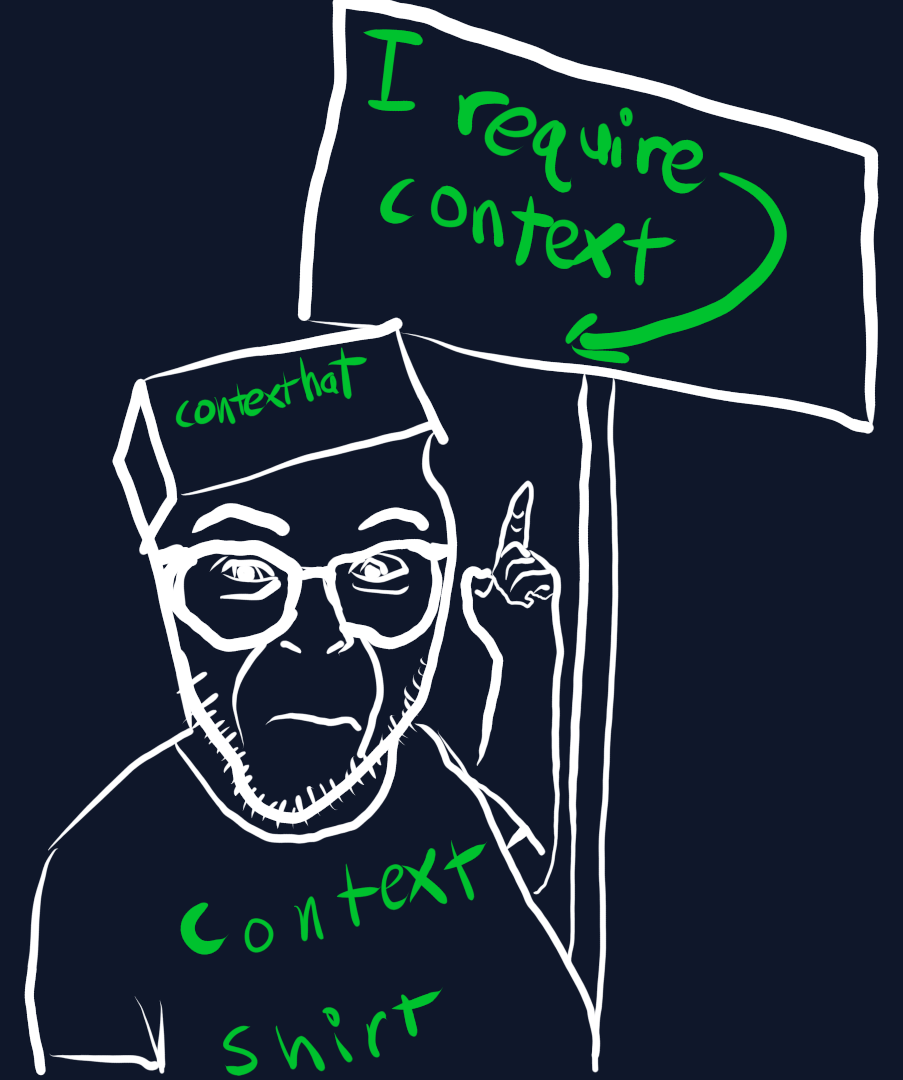
Here’s a dumb example of context growing over time:
- 1s: What
- 2s: What is
- 3s: What is le
- 4s: What is le capital
- 5s: What is le capital of
- 6s: What is le capital of France?
If an LLM tries to answer my prompt before getting the full context, shit will suck. France is le gatekeeper, and everything before it is effectively a prerequisite. In this example, what matters is the latency of the last packet.
Those poor packets that were attacken by the kraken? WebRTC actually had seconds to retransmit with no latency penalty. The AI agent can process faster than real-time to catch up without the end user (aka YOU) noticing a thing.
So that’s what Mr. MoQ does. No packet left behind: we keep retransmitting until the AI actually needs the audio.
It’s not expensive either: audio is tiny. 1s of Opus @ 64Kbps is 8KB, originally sent as 50 tiny packets, but it can be retransmitted as ~6 QUIC packets. We have literal seconds to retransmit 6 packets to avoid any user impact.
And if we manage to accomplish this herculean task: all the context arrives in time!
The model no longer has to guess. It no longer has to be trained on silence or distortion either. This is a pure user experience win.
Not Just Mics
Guess what? WebRTC doesn’t just suck for STT, it also sucks for TTS.

Fun Fact: WebRTC renders audio (and video) based on when it arrives, not when it is supposed to be rendered. Every other protocol uses timestamps, but Mr. WebRTC barely looks at them, because accuracy is a non-goal. Sure, it’ll nudge audio and video into sync by a few milliseconds, but good luck sending the video 500ms after the audio.
This is a huge problem for voice AI. TTS is generated faster than real-time, stamping each packet with a future timestamp. But in order to play back audio at the correct time with WebRTC… the agent needs to sleep before transmitting each packet.
And if there’s any packet loss, our TTS is lost, will never be retransmitted, tokens burned, yada yada.
If only there was some way to signal when to render each audio packet. A stamp of sorts.
Random Access Memory
Welcome back to the future Marty. We faster than real-time now.
RAM has this amazing property of being stupidly expensive. And being able to store stuff locally. You know, like audio that needs to be played over the speakers.
We put a timestamp on each audio frame and use that to determine when to play it out of RAM. Absurd, I know.
It’s how the Youtubes keeps playing back video even when you lose network connectivity. MoQ does the same thing but for voice AI. Your sick baking recipe won’t be subject to surprise congestion.
And don’t you fret, 2 minutes of audio is only 1MB. You’re not going to have to take out a loan to buy another RAM stick.
Disclaimer: this behavior is not IETF standardized. It’s something only my moq.dev clients (and thus Pipecat) support. Be my guest if you want to argue with Cisco and get it into the official standards.
Enter the Antagonist
Then why is OpenAI using WebRTC?
WebRTC is the state of the art for real-time, conversational audio.
It’s available in every browser via libwebrtc, a C++ monolith maintained by Google.
It’s so complicated and sophisticated that Safari and Firefox use libwebrtc too, rather than vibe code their own like everything else.
The problem is that WebRTC is the Google Meet client. It is designed specifically for Google’s conferencing product, not their voice AI product (they use WebSocket), and certainly not your product.
quite the anti-competitive ruse tbh. Google can ship product updates without consulting the other browser vendors. No other conferencing app can do this on the web.
Fun Fact: This is why every other conferencing app recommends a native client. Otherwise, they can only reach parity with Google Meet at best. Native apps can do whatever they want over UDP instead.
Fix It Fix It Fix It
So that’s why your hyper deluxe ChatGPT™ voice AI model, after billions invested, has the audacity to ask: can you repeat that?
I could dump on WebRTC for days, but I want to be positive for a change. Here’s how to fix it.
First off, I need to acknowledge what WebRTC does have:
- NetEQ is amazing. It changes audio playback speed based on jitter. But not packet loss.
- Audio retransmissions can now be enabled via SDP munging (disgusting). But the NetEQ jitter buffer won’t wait for them.
- The playout-delay RTP extension is perfect for voice AI. But it’s video only.
To fix WebRTC, we need to petition Google to:
- Implement playout-delay for audio.
- Allow the jitter buffer to grow, both in the past and into the future (for TTS).
- Render audio based on timestamps not vibes.
- IDK some RTP extension to bump the track generation (for interruptions).
And of course, petition the wider WebRTC ecosystem to do the same.
Gatekept
The main problem with WebRTC will remain: Google is the gatekeeper.
Your Claude friend can’t just fork libwebrtc and fix these issues.
Google is required for web support, at least until Theo spends $420k to rewrite Chromium in Rust.
I think it’s amazing that playout-delay was merged 10 years ago and audio still doesn’t have it. Higher latency/quality playback has never been a priority for WebRTC, since Google Meet is the only product that matters.
Fun Fact: This is why I ended up creating MoQ. We tried using WebRTC at Twitch but the real-time-or-else made for a poor user experience. I am but a humble software engineer, and despite trying, we failed to petition Google.
But OpenAI has enough sway to fix WebRTC. One long-deserved improvement is WARP (not that WARP), which was hot on the heels of my last blog post. Keep at it Justin, or join the Dark Side with me.
Enter The Protagonist
In my humble and handsome opinion, it’s time to invest in a better transport. Take a few of the M’s from the B’s and T’s; nobody will notice.
A voice agent should never ask the user to retransmit a prompt.
A voice agent should instead ask the transport to retransmit a prompt.
Spoiler alert: Media over QUIC is that better transport btw.
Pipecat now supports MoQ! A huge thank you to Vanessa and Claude Code for putting in the work and putting up with my constant “improvements”.
Here’s a crude demo with my credit card deets attached. please don’t milk me dry.
Note that I’ve only spent like a day of work prompting on this.
It took me significantly longer to write this damn blog post.
Don’t judge too harshly pls.
And yes, it sometimes says “can you repeat that?” which is hilariously ironic. The first/last hop is MoQ, but I don’t control the rest of the pipeline. If Deepgram, OpenAI, or Cartesia drop ur packets then there’s nothing I can do about it.
Interruptions
We’re not done yet. I wanted to shill the MoQ in the middle of the blog and use the rest…

Sometimes the AI is monologuing and you need to tell it to STFU. It’s pretty easy to do with WebRTC because of the sleep before sending each packet. But with MoQ, we need some signal to tell the player to abandon the playout buffer.
Here’s the naive approach without a signal:
My solution for this is deviously clever. So clever.
For MoQ, we’ve prioritized the ability to add/remove tracks dynamically. Most media protocols have fixed tracks and it’s a pain in the butt: HLS, DASH, RTMP, WebRTC, etc. You can’t add 1080p, or switch codecs, after a broadcast is live.
My super clever idea is to reuse this functionality for interruptions. Just make a new audio track (and remove the old one) as the STFU Signal™.
This works on a generic MoQ player. We automatically switch tracks, using timestamps to keep synchronization.
ez
Butt-to-Butt
Hey stupid, your blog post is wrong. You didn’t mention speech-to-speech?
Look, Dunning-Kruger is the only reason the previous blog post exists. I didn’t know speech-to-speech existed until the comment section. What can I say but ur welcome.
DISCLAIMER: I still haven’t done any research on the state of voice AI.
I give you full permission to tweet @kixelated ur stupid.
The idea behind speech-to-speech is to cut out the text middleman. The disjoint STT -> LLM -> TTS pipelines get smashed together, reducing latency while preserving verbal context. OpenAI is the pioneer in this space and they deserve mad props.
So this vindicates WebRTC right? The speech-to-speech latency can be low enough to justify dropping packets?
Not so fast literary strawman. There’s a fundamental trade-off between latency and quality.
Latency Budgets
The more time you have to work on something, the better the result.
Good things take time, like Fable changing a single line in README.md because I’m too poor to pay 3.5x for ultrafast.
Networks are the same. The more time you have to transmit something, the better the quality. It’s why retransmits exist in the first place.
Unless you’re doing broadcast TV, which still uses MPEG-TS and still results in glitchy messes. Seriously wtf guys, TV is no longer over the air, and we don’t need 188 byte packets any longer.
Anyway, the amount of time a user is willing to wait for something is a product decision. Put on your big boye pants, it’s time to be a PM. Do users want something fast and lossy, or slow and reliable?
Why not both?
That’s the idea behind speech-to-speech. Do a low-latency STS pass for easy prompts and to generate filler noise.
Human: What is le capital of France?
ChatGPT: One second, let me look that up.
Boom, even that useless “I’m thinking” response makes the human feel good chemicals. But more importantly for us anti-PMs, it buys us enough time to start a slower pass.
I don’t work at a frontier lab so this is all speculation, but I imagine STT->LLM->TTS is still used for these slower passes. A STS model with Astra/Fable quality is absolutely ideal… but probably not worth the investment.
Either way, doesn’t matter if it’s STS or STT->LLM->TTS. The only thing that matters is the latency budget.
MoQ do Both
One of the core problems we’re trying to fix with MoQ is the whole “one transport per latency” issue in the industry. It’s face-palmingly common to use different protocols based on the latency budget.
For example, an all-hands presentation where the speakers use Zoom, while everybody else watches via HLS and can’t participate.
Fuck that noise, MoQ supports multiple latency targets with a single connection. In the case of voice AI:
- real-time latency for rapid replies (STS).
- loss-less quality for slow replies (STT->LLM->TTS).
How? Every MoQ subscription includes how long the subscriber is willing to wait.
Your real-time model can have a maximum latency of 500ms while your more accurate model might have a maximum latency of 5s. Both get coalesced into a single upstream subscription which can fanout.
And note that this is the maximum latency. The latency is 0 except during terrible network conditions, and eventually we give up. This is the core difference between MoQ and TCP/WebSocket for Voice AI.
Your transport latency should be aligned with your product latency budget.
It’s Simple: Predict the Future
One more strawman to beat into the dirt.
Hey stupid, your blog post is wrong. WebRTC doesn’t care about packet loss because it uses FEC.
M8 go read my previous blog posts: never use datagrams and forward error correction. This is like my dumber one hot take.
WebRTC (and Opus) include Forward Error Correction to help mask packet loss. The idea is to stuff a crappier, lower bitrate copy of the previous audio frame into the next packet.
But only a single last packet. It can’t even handle two lost packets in a row, let alone a full network blip.
This is fine for WebRTC because it doesn’t give a shit about audio older than 30ms. But it’s not fine for voice AI or really anything on the internet. Packet loss due to congestion is bursty, not random.
A common “fix” is to spread these copies over time, so you can handle X lost packets in a row. See Opus 1.5. All of this extra data has a real cost, and if you don’t know what you’re doing (and you don’t), then you will aggravate bufferbloat.
In my humble (and attractive) opinion, FEC is best for huge RTTs, like transmitting to le moon.
In <current year>, we instead use CDNs to shrink the lossy first/last mile which makes retransmissions OP.
Why send more bytes spread over 400ms, instead of retransmitting in 40ms?
But if a WebRTC warrior insists, QUIC libraries can retransmit stream data as many times as they want. Basically RED but based on byte offsets, not packets, and fully transparent to the receiver. That’s a free idea btw.
More Free Ideas
I should end the blog post here but seriously, I’m 3 weeks in and need this shit forwarded internally. Take a screenshot of it on your internal Slack.
Hey, OpenAI. I’m sorry for flaming you for representing state-of-the-art for voice AI. We may have gotten off on the wrong foot.
Hey, Anthropic. I’m sorry that I called you the orange butthole company. We may have gotten off on the wrong foot.
I’ll make it up to both of you.
Here’s some free ideas you could prototype with your unlimited Fable/Astro 7 tokens.
Just give me Co-Authored-By credit on the git commits.
Or Scion, I don’t care.
Please I need more green squares on my Github.
Decouple Compute
I know you have obscene amounts of capital, but getting GPUs next to every single user in the world is hard. But getting cheap DELL servers next to every single user in the world is easy.
- Run
moq-relaywithin CDN edges. - Run models where GPUs are available.
Like I said earlier, this is basically the premise of CDNs. A huge number of edge nodes close to users minimizes the congested first/last mile. Over-provision the backbone so you can get the traffic to the GPUs without congestion.
You can independently scale network and compute.
Which I hope you guys already do, and are big enough to justify a custom Voice AI protocol instead of using a standardized MoQ implementation.
For everybody else, MoQ is generic enough to serve more than just Voice AI. Think of MoQ like a live HTTP. It’s an IETF standard after all, the same body that does that HTTP thing.
In fact, my first big customer is using moq.pro to mass fanout JSON blobs. Literally a generic pub/sub protocol masquerading as an A/V protocol.
Prioritize Context
I’m a transport and ideas guy, not an AI scientist. Don’t flame me if this is obvious and/or impossible.
The core problem with WebRTC+AI is that there’s a disconnect between the model and the transport. This blog focused on aligning latency… but what about aligning context?
After all, not all tokens have the same weight. If we knew the relative importance of each token, we could use that to make informed networking decisions.
high priority: what capital france
low priority: is le
zero priority: <silence>
To implement this via MoQ, you would split the audio track into separate tracks that are encoded independently. The high priority track would get first dibs on available bandwidth, and the subscriber would wait longer for it.
But TBH the hard part is actually giving a shit. Audio bitrates are so low that you rarely get a chance to prioritize anyway, and it’s not worth the hassle of doing a client-side tokenizer. Maybe it could matter for video tho.
Back-fill that Boye
The other problem with dropping audio after 30ms is that it’s a one-way door.
Bold prediction: The next Claudism will be one-way door after it’s been trained on this post.
Once a network transport decides to drop data over the network, it can’t be used for other things. Now, I don’t know if frontier labs store raw audio… but maybe they should.
Eventually the AI model has to stop waiting and guess based on incomplete data. Did it do a good job or bad job? How can we know?
Well… maybe don’t actually drop the audio; keep that shit in RAM.
Audio is tiny after all.
We can set max-latency to 10 minutes and it will be transmitted eventually at the lowest priority.
We backfill that boye only when the network has fully recovered.
Why backfill via MoQ? Why not save it as a file and train on it later?
Vroom vroom, the GPU is warm. Ask the model if it did a good job guessing what the user said X seconds ago while the context is cached. Use it as training data. IDK I’m not a scientist.
FIN
Oh god I’ve spent so long on this blog post. Please upvote on your favorite link aggregator of choice.
I’m about to YOLO into a startup, so hit me up if you’re interested in acquiring a slice of Kixel, Corp. You get a discount while I’m spiritually unemployed and easy to impress.
Also hit me up if you’re tired of being well paid and want to YOLO into a job. There’s already a second nerd starting next month.