published 8/16/2026
Open For Business
I’m starting a company: Kixel, Corp. We can now exchange goods and services.
The first good is moq.pro, a managed MoQ CDN.

Why?
To make deplorable amounts of money.
I’m kidding. The real reason is even more deplorable: I want you to use MoQ.
I’ve been contracting with a few robotics companies already. MoQ is being used in production to pilot boats, drones, trucks, and to fold t-shirts. Even over degraded Starlink connections, it just works™.
In my humble (and handsome) experience, the most frequent adoption blocker is infrastructure.
It’s easy to vibe code using the moq.dev libraries, but horizontally scaling across the planet is hard.
A lot of companies settle for a single moq-relay instance and leave a # TODO SCALE comment.
HEY GUESS WHAT? I’ve designed and operated a baremetal CDN (Twitch). I’ve also done it for real-time (Discord). I kind of know how to do this thing.
So here’s a business proposition for you: pay me and I’ll host the infrastructure.
SCALING

Clients connect to their closest edge server for the best latency and quality.

Clients can publish any number of broadcasts, discoverable by other clients.
Clients subscribe to tracks within a broadcast. Duplicate subscriptions are merged within the CDN and routed to the broadcaster.
Every additional subscriber has a diminishing cost! We SCALE SCALE SCALE.
FEATURES
Every blog post I write about MoQ I rave about the potential. There are SO MANY COOL THINGS YOU COULD DO WITH MOQ.
But first there’s a lot of mundane shit to implement. Backwards compatibility, authorization, metrics, etc. The type of stuff that makes you want to stay in bed. The unfortunate reality is that scale is not the problem until everything else just works™.
My goal with moq.pro is to make it easy to start using MoQ now. I’ll do the boring stuff so you can focus on the cool stuff.
With this first release we have:
- RTMP / WebRTC / SRT support: So you don’t need to migrate everything over night.
- HLS recordings: Dump prior broadcasts so you can watch them later.
- Real-time stats: Literally updated every second; never hit F5.
- Scoped Authorization: Use keys/tokens to control access to your broadcasts.
All of this functionality is open source via moq.dev. moq.pro is the hosted glue that makes stuff easier to use.
Cost
I’ll be honest, I don’t like charging money for things. I am a bad business person. There’s a reason why I quit my job to work on open source. A normal human bean has a job and a salary.
moq.pro is $0.04/GB for all outbound network traffic. Inbound is free so if nobody is watching your broadcast, you pay nothing. We charge based on usage and not vibes.
Meanwhile, most WebRTC providers charge based on time. Want to stream a low-resolution security camera on Agora/Daily (public pricing)? That’ll be $5.75 per day for the broadcaster and each viewer. wtf
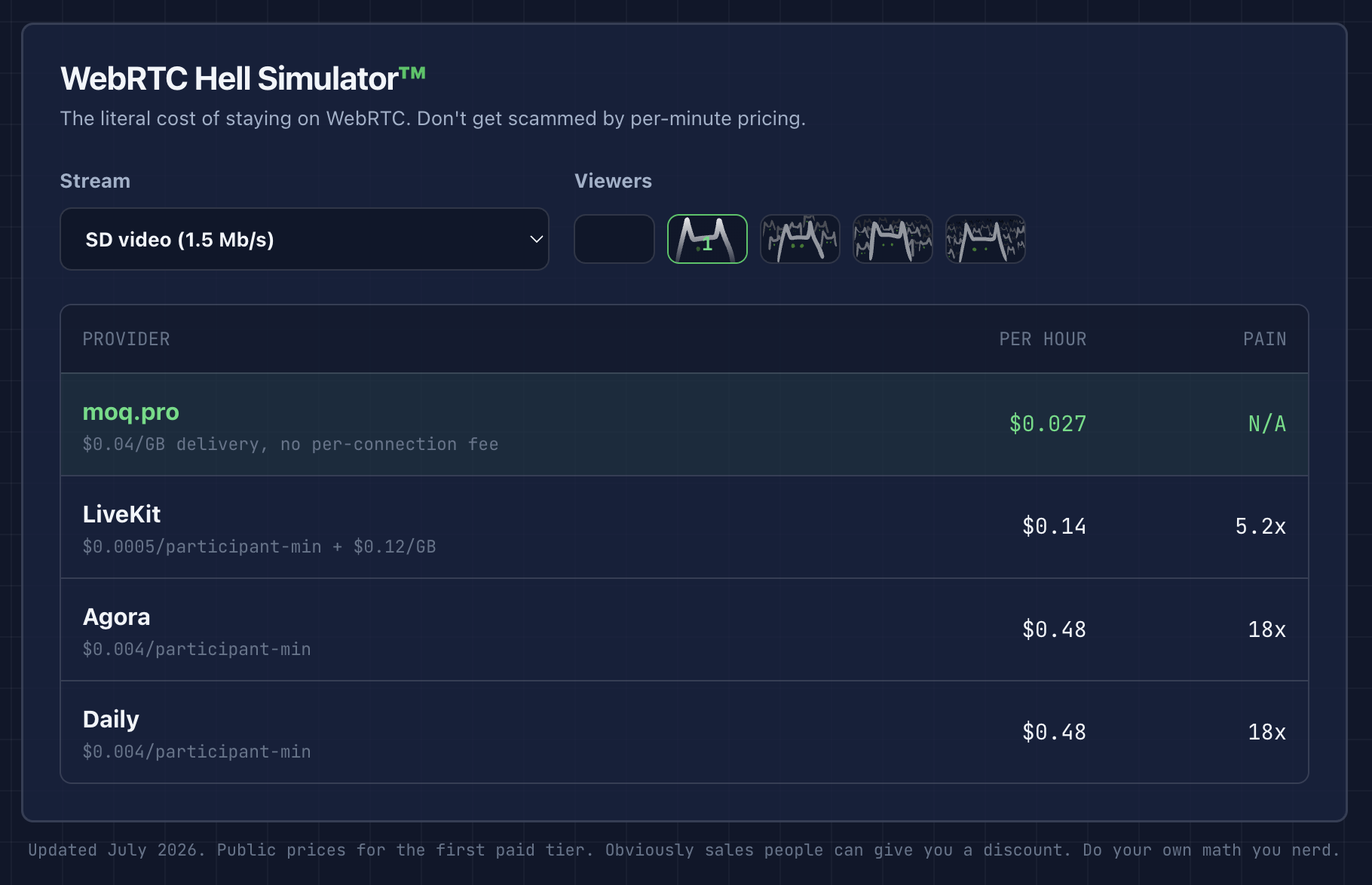
Dante got it wrong, there’s an extra level.
Use MoQ instead. Your security camera costs $0 when nobody is watching, nor will it transmit anything. If you’re using a cloud WebRTC provider, convince your CFO to let you prototype MoQ for that sweet capex savings. The only upfront cost is a few Claude sessions.
You will always be able to self-host. Lock-in is the antithesis of a standard. Compatible competition drives prices down. Blah blah blah. My goal is to get you to use MoQ. And I think the best way to do that is by making it cheap AND easy.
But before you self-host, just remember that AWS charges $0.09/GB (public pricing) for EC2 outbound network traffic. Plus you have to pay for those EC2 instances. Bandwidth is expensive yo. IMO you should pay me instead.
The Standard
Speaking of standards, moq-transport will be an RFC one day. There’s quite a few companies working on their own CDN offering: Cloudflare, Akamai, Fastly, AWS, etc. But progress is so slow; it’s embarrassing.
Hopefully this gives the group a kick in the butt. Stop arguing about how to encode an integer. We don’t need more tech demos. Start charging customers for your services.
All of the moq.dev clients are fully compatible with the standard, supporting drafts 14-19+.
You can switch out the https://cdn.moq.pro URL with a different CDN provider and should just work™.
The should is there because the moq-transport standard is bloated and even worse: optional.
There’s a lot of cruft that I don’t implement in the moq.dev libraries, and to be fair, zero implementations fully implement the standard.
Anyway, even if you only use moq.pro to prototype before switching to a big boye CDN, it’s still a win for MoQ. The entire point of a standard is so you can switch out cloud providers without eating dirt. And the entire point of open-source is so cloud providers can sell something they didn’t make.

also me when I trace memes
Try it!
Fun fact: here’s a few of the ways to watch MoQ broadcasts via moq.pro:
- Web: https://moq.watch/demo/bbb.hang
- ffmpeg:
moq --client-connect "https://cdn.moq.pro/demo/bbb.hang" export ts | ffplay - - Gstreamer:
gst-launch-1.0 -v -e moqsrc name=s url=https://cdn.moq.pro/demo broadcast=bbb.hang - OBS: Create a MoQ source for
https://cdn.moq.pro/demo/bbb.hang - RTMP:
rtmps://cdn.moq.pro:1935/demo/bbb.hang - SRT:
srt://cdn.moq.pro:877?latency=500&streamid=#!::r=demo/bbb.hang,m=request - WebRTC:
https://cdn.moq.pro/whep/demo/bbb.hang
Of course there are libraries for Rust (native) and Typescript (web). There are Rust-based bindings for C, Python, Go, Swift, and Kotlin.
Many of these are written by Mr. Claude. I’m a fraud, I know, I don’t actually know Kotlin/Swift and most definitely don’t want to work on the SRT integration. Yell if you run into issues and better yet, point Mr. Claude towards the repo to donate some tokens.
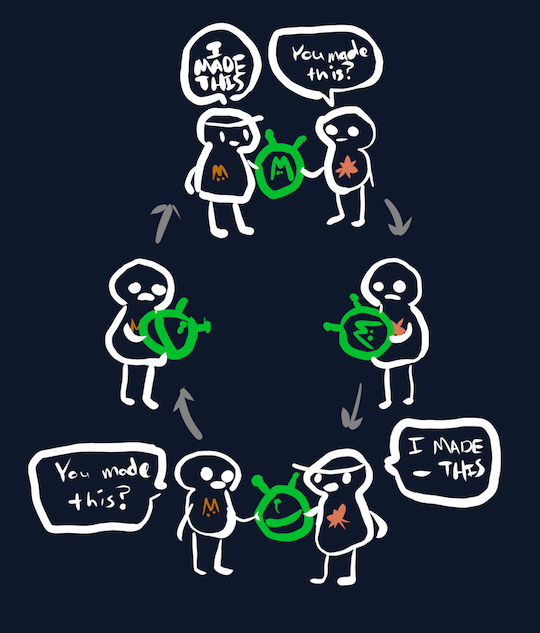
Reality is a bubble.
The Roadmap
If you need something, let me know. Or post on the Discord.
Next I’m working on:
- DVR: Seek backwards during a live stream
- HLS export: Use MoQ for ingest, HLS for distribution
- Transcoding: On-demand renditions (ex. 240p, 360p, 720p).
- Voice AI: Generate captions, talk to agents, etc.
- CDN Sync: Use moq.pro and/or Cloudflare and/or self-host.
- Performance: Sans IO core + iouring runtime.
kewl.

The Company
Hit me up if you want to throw money at this endeavor. Or you (or someone you know) wants to leave your cushy job. Especially if you speak the language of business.
- Email me:
hillo@moq.pro - Meet me: https://meet.kixel.me
Written by @kixelated.
